
How often should air conditioning be serviced in Canberra? Clear timelines and local tips
How often should air conditioning be serviced in Canberra? Clear timelines and local tips In Canberra, plan filter cleaning every 1–2 months during peak seasons, and book a professional service annually. Ducted reverse‑c
How often should air conditioning be serviced in Canberra? Clear timelines and local tips
In Canberra, plan filter cleaning every 1–2 months during peak seasons, and book a professional service annually. Ducted reverse‑cycle systems used for winter heating benefit from a pre‑winter check; heavy use, pets or bushfire smoke exposure can justify servicing twice yearly. Commercial or short‑term rental properties often require quarterly inspections.
If you want a technician to handle the lot, book a professional air conditioning service in Canberra before winter heating or summer cooling ramps up.
Key takeaways
- Annual professional servicing is the baseline in Canberra; biannual for heavy use, winter heating, or smoke-prone homes.
- Clean reusable filters every 4–8 weeks in peak seasons to protect efficiency and indoor air quality.
- Reverse-cycle ducted systems should be serviced pre‑winter to avoid frosty-morning breakdowns and defrost headaches.
- Electrical and refrigerant tasks are for licensed technicians only; look for ARCtick authorisation and Access Canberra licences.
- Prices vary by system size, access and condition; a routine Canberra service is typically a few hundred dollars (guide only).
Contents
- Is it urgent to service my air conditioner if it’s still running?
- How often should Canberra homes service their air conditioning?
- How often for ducted, split and multi-split systems?
- What does a technician do during a service?
- Which Canberra factors change service frequency?
- How often should I clean or replace filters?
- What does air conditioning servicing cost in Canberra? (guide)
- What symptoms mean I should service sooner?
- What maintenance can I safely do myself?
- When is it a repair job, not a routine service?
- How do rentals, strata and commercial sites handle servicing?
- Do brands and energy ratings change service needs?
- Frequently asked questions
Is it urgent to service my air conditioner if it’s still running?
If it’s running reasonably and there’s no burning smell, tripped breakers, or leaks, it can usually wait 2–6 weeks. If the system is short-cycling, icing, tripping power, leaking water, or blowing a burnt smell, call now. Electrical and refrigerant issues must be handled by licensed technicians.
- Call Capital Climate Solutions on 0434 096 497 for priority assistance if you suspect a safety issue.
- Don’t open electrical covers or handle refrigerant lines. ARCtick licence is required for refrigerant work; see lookforthetick.com.au.
- Access Canberra licensing and AS/NZS 3000 apply to electrical work; book a professional for inspections and repairs.
How often should Canberra homes service their air conditioning?
Most homes should book a professional service annually, with filters cleaned every 4–8 weeks in peak use. Because Canberra uses reverse-cycle systems heavily for winter heating, a pre‑winter service (April–May) is often the best timing. Households with higher dust, pets or allergies may benefit from six‑monthly servicing.
- Annual service for general use, especially if cooling in summer and heating in winter.
- Six‑monthly for heavy winter heating, pet hair, or smoke exposure (bushfire season).
- Commercial and short‑stay rentals: quarterly checks to meet compliance, uptime and tenant expectations.
For a full professional checkup, you can schedule air conditioning servicing in Canberra to line up with your season changeover.
How often for ducted, split and multi-split systems?
Frequency depends on system type, usage and environment. As a rule, ducted systems used for heating need more frequent attention than a lightly used bedroom split.
| System type | Typical Canberra use | Filter clean | Professional service |
|---|---|---|---|
| Single split system | Seasonal cooling + occasional heating | Every 4–8 weeks in-use | Every 12 months |
| Multi‑split (2–5 heads) | Multiple rooms, mixed use | Each indoor unit every 4–8 weeks | Every 12 months; 6 months if heavy use |
| Ducted reverse‑cycle | Whole‑home cooling + winter heating | Return air filter monthly in winter | Every 12 months; pre‑winter preferred |
| Commercial ducted/VRF | Daily operation | Monthly or per site plan | Quarterly or per contract |
If your ducted system struggles on frosty mornings, read our explainer on why defrost happens and what to do: Defrost Cycle Explained.
What does a technician do during a service?
A proper service is more than a filter clean. It’s a head‑to‑toe inspection and optimisation designed to keep efficiency high and failures low.
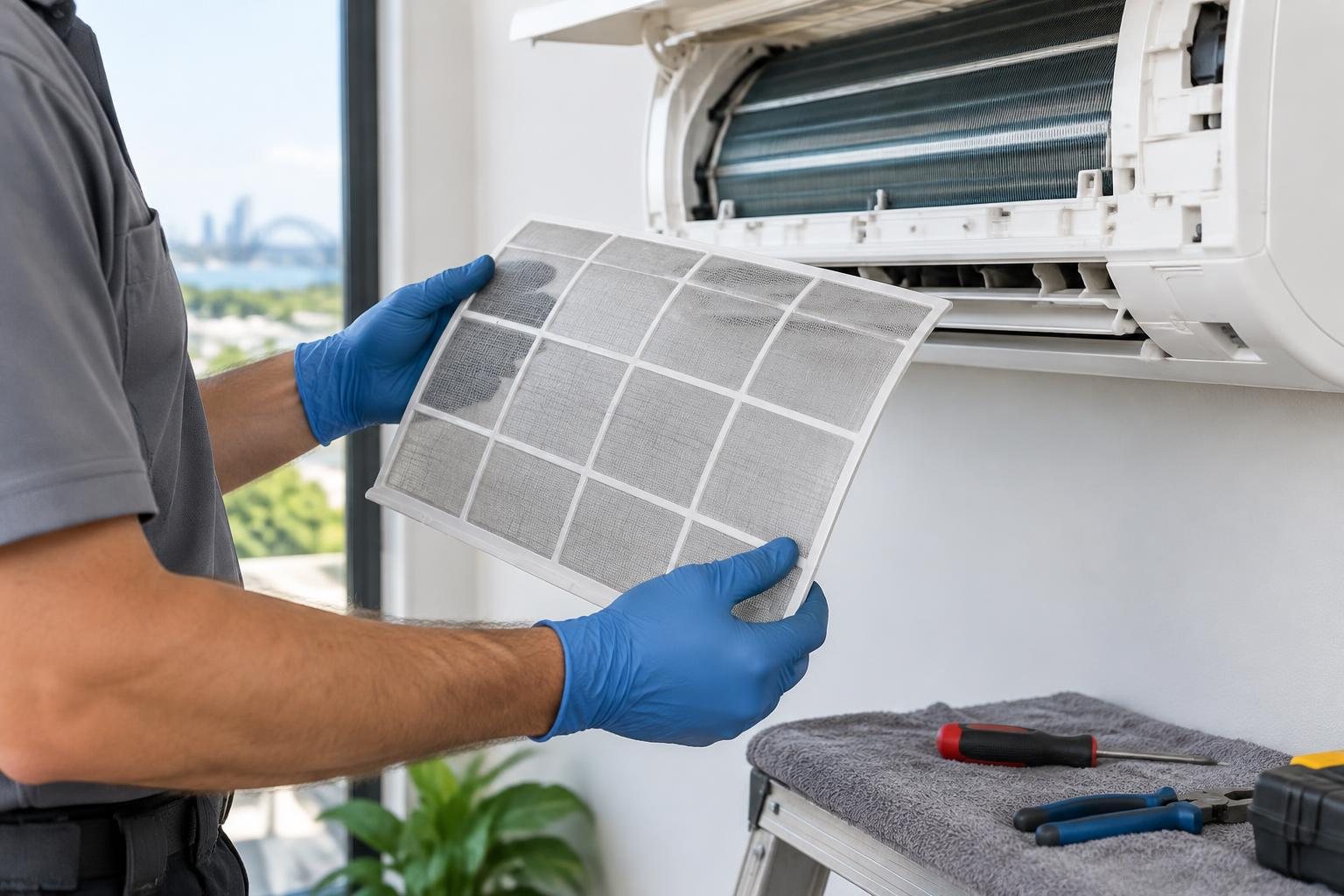
- Indoor unit: clean or replace filters, inspect coil and drain, sanitise if needed, check fan, thermistor, and louvres, verify condensate pump (if fitted).
- Outdoor unit: clear debris, check coil condition, fan and motor operation, tighten terminals, check insulation, inspect for oil stains that hint at leaks.
- Ducted systems: inspect return air grille, check duct integrity, plenum and branches for leaks; test zone motors and dampers; confirm return path via grilles or jump ducts.
- Controls: test thermostats, smart controls, and scheduling; verify temperature splits and mode changes; review error history if available.
- Performance: measure supply/return temperatures, airflows, and static pressure (ducted); confirm defrost operation and heating output.
- Safety: check isolation switch, electrical connections (AS/NZS 3000 compliant), and overcurrent protection. Electrical tests are for licensed professionals.
- Refrigerant system: check pressures/temps only where diagnostics require; refrigerant handling must be by an ARCtick‑authorised tech.
If biofilm or mould is present, we may recommend a deeper clean or coil wash. That’s beyond a basic service and often booked as a dedicated air conditioner cleaning visit.
Which Canberra factors change service frequency?
Canberra’s climate and housing stock are unique, and they influence how often you should service.
- Frosty winters and hot summers: −5°C mornings and 35°C+ days push reverse‑cycle systems hard. Pre‑winter servicing improves reliability and cuts defrost frustration.
- Bushfire smoke and dust: Filters load quickly; plan more frequent cleaning and consider higher‑efficiency filters where compatible.
- Older brick‑veneer homes (1960s–80s): Leaky envelopes and older ducts can strain systems; duct inspections and resealing may be recommended.
- Strata units and terraces (e.g., Belconnen, Braddon): Body corporate rules may dictate service intervals; shared plant rooms need clear scheduling.
- Gas‑to‑electric transition: More households are heating with reverse‑cycle; that increases winter runtime and justifies pre‑season checks.
- Utilities and metering: Evoenergy and ActewAGL metering or tariffs don’t change service intervals, but efficient operation can help manage bills.
If your system consistently underheats in winter, our guide on Reverse Cycle Heating explains settings and behaviours that improve warmth and efficiency.
How often should I clean or replace filters?
Clean reusable filters every 4–8 weeks during heavy use. In Canberra, that often means monthly in winter for ducted heating and monthly in peak summer for splits. Replace disposable media as per the product label or sooner if visibly dusty.
- Bedroom split systems: quick vacuum or rinse monthly in summer, then check every two months in shoulder seasons.
- Ducted return filters: check monthly in winter; clogged returns cause high pressure and poor airflow.
- After smoke events: inspect within a week; fine particulates saturate filters quickly and can carry odours.
For recurring odours or visible coil contamination, schedule a hygienic clean via our air conditioner cleaning service.
What does air conditioning servicing cost in Canberra? (guide)
The figures below are indicative only and not a quote. Actual costs depend on unit size, access, condition, and the scope required on the day.
| Service item | Typical Canberra guide price (AUD) | Notes |
|---|---|---|
| Routine split system service | $160–$250 | Basic clean, checks and performance test; parts extra. |
| Ducted system seasonal service | $250–$450 | Includes ducts/zone checks; larger homes toward upper range. |
| Hygienic indoor coil clean | $180–$350 | When mould/biofilm present; varies by access and severity. |
| Diagnostic callout (fault finding) | $150–$220 | Weekday rates; repairs/parts additional. |
| Refrigerant leak test and repair | $300–$800+ | Highly variable; ARCtick tech required; gas cost extra. |
| Zone motor or actuator replacement | $250–$500+ | Part and labour; depends on brand and access. |
Servicing supports efficiency. The federal Energy Rating Label (GEMS) provides guidance on efficiency and capacity; see energyrating.gov.au for official information.
What symptoms mean I should service sooner?
Any performance drop, unusual noise, or error code is a hint your system needs attention. The table below helps triage timing. If unsure, book a check. For more warning signs, see our article 10 Signs Your Air Conditioner Needs Repair.
| Symptom | Likely cause | Urgency |
|---|---|---|
| Poor airflow or weak heating | Clogged filters, blocked return, duct leak | Service soon (2–4 weeks) |
| Water dripping indoors | Blocked drain, iced coil, pump fault | Prompt service (within a few days) |
| Unit ices up in winter | Normal defrost or airflow issue | Check settings; service if persistent |
| Clicking/whirring in ducts | Zone motor or damper issue | Service sooner (1–2 weeks) |
| Burning smell or tripping breaker | Electrical fault | Stop use and call immediately |
| Musty odours | Dirty coil or condensate | Service and hygienic clean |
What maintenance can I safely do myself?
Homeowners can do simple cleaning and visual checks. Anything electrical or refrigerant‑related must be performed by licensed professionals.
- Clean reusable filters: vacuum or rinse, dry fully, and refit correctly.
- Clear outdoor unit: remove leaves, keep 300–500 mm clearance for airflow.
- Check return air path: ensure doors have transfer grilles or undercuts for ducted air to return.
- Review settings: correct mode, temperature and fan speeds; schedule or smart control checks.
- No DIY on refrigerant: only ARCtick‑authorised technicians may handle gas; verify at lookforthetick.com.au.
When is it a repair job, not a routine service?
If the unit is not heating/cooling, trips power, displays fault codes, or shows oil around joints, it’s a repair, not a routine service. Book diagnostics rather than a basic service to avoid double handling. For faults, see our air conditioning repairs page.
During cold snaps in areas like Tuggeranong, failures often appear at first winter peak. A pre‑winter service helps catch weak components before they fail under load.
How do rentals, strata and commercial sites handle servicing?
Responsibilities vary by tenancy agreements and bylaws, but most strata require owners to maintain their own units and coordinate with building managers for access.
- Rentals: landlords typically arrange servicing; tenants should clean filters regularly.
- Strata: inform the building manager ahead of rooftop or plant‑room access; follow noise and time restrictions.
- Commercial: quarterly plans help maintain uptime and indoor air quality; filter management is crucial for open hours.
Do brands and energy ratings change service needs?
Servicing intervals are broadly similar across brands, but features like advanced filtration or smart controls may require specific cleaning procedures. Check your manual and book a technician familiar with your brand. Daikin systems are common locally; see our Daikin brand page for insights.
Efficient operation supports the performance represented by the Energy Rating Label. Learn how the label works and why clean filters matter at the official Energy Rating website.
Frequently asked questions
How often should a ducted reverse‑cycle system be serviced in Canberra?
Annually as a baseline, with a pre‑winter service recommended because heating is the heaviest load. If you rely on it daily through winter, or you’ve had smoke or dust issues, step up to six‑monthly servicing and monthly return‑air filter checks in winter.
Do Canberra’s frosts and defrost cycles mean I need more servicing?
Defrost is normal in sub‑zero mornings, but poor airflow or blocked filters can make it worse. A pre‑winter service optimises airflow and confirms sensors and controls. If defrost feels excessive, a technician should verify operation and duct pressure.
Is filter cleaning really that important?
Yes. Dirty filters cause low airflow, noisy operation, poor heating and icing. In Canberra, blocked returns can seriously reduce winter heating. Clean reusable filters every 4–8 weeks in peak use and inspect sooner after smoke or dust events.
What’s included in a “standard” service versus a deep clean?
A standard service covers filter cleaning, general inspection, electrical checks, testing and basic sanitation. A deep clean involves chemical coil cleaning, drain sanitising and sometimes disassembly for stubborn biofilm or mould. Technicians recommend a deep clean when odours, mould or heavy contamination are present.
Can I top up my own refrigerant?
No. Refrigerant handling requires an ARCtick‑authorised technician under Australian law. DIY work risks fines, system damage and safety hazards. Check licences at the official portal: lookforthetick.com.au. If you suspect low refrigerant, book diagnostics rather than a routine service.
When is the best month to book a service in Canberra?
Book March–May for pre‑winter heating readiness, or September–November before summer. You’ll avoid peak breakdown queues and get better availability. If winter heating is critical, prioritise the pre‑winter window to beat frosty‑morning failures and long wait times.
Will servicing reduce my electricity bills?
It can help by restoring airflow and heat exchange efficiency, so the unit doesn’t work as hard. Clean filters and properly sealed ducts stop energy waste. The exact savings vary with system condition and usage; servicing supports the performance indicated by Energy Rating labels.
What if my unit is still under warranty?
Follow the manufacturer’s maintenance guidance, keep service records, and use licensed technicians. Warranty conditions vary, but neglecting maintenance can complicate claims. If in doubt, ask us to document work clearly and retain photos and reports from each service visit.
My ducted system is noisy in bedrooms at night. Is that a service issue?
Sometimes. Noise can indicate clogged filters, high static pressure, or zoning/duct design issues. Servicing can diagnose pressure and damper operation. For design improvements, see our guides on zoning and airflow in the blog for practical fixes and expectations.
What if my aircon smells musty or “dirty socks”?
That’s often biofilm on coils or drains. A standard service may reduce it, but a hygienic clean is usually required to fully treat odours. Improve filtration, run periodic drying modes, and maintain regular servicing to prevent recurrence.
Can smart controls help reduce servicing needs?
They don’t replace servicing, but better schedules, gentle ramping and correct mode selection reduce stress on components. If you’re considering smart add‑ons for ducted systems, see our Canberra guide to smart controls for pros, cons and costs.
Need your system serviced before the Canberra chill or heat hits? Call Capital Climate Solutions on 0434 096 497 or send us a message. We service splits, multi‑splits and ducted systems across the ACT and nearby Queanbeyan.
Related reading:
What a useful service report should tell you
A useful report identifies the system, records the condition of filters, coils, drains and outdoor airflow, and separates completed cleaning from recommended repairs. Ask for photographs of accessible problem areas and an explanation of any additional charge before approving work. Checks should follow the manufacturer's instructions and the system's condition; not every visit requires opening the refrigerant circuit.
Filter cleaning can often be performed by the owner when the manual allows it. Electrical testing, refrigerant handling and dismantling equipment are professional tasks. Switch the system off before removing user-serviceable filters and never spray water into electrical components. A persistent smell or water leak needs diagnosis, not simply more fragrance or a quick filter wipe.
Set a maintenance interval for the actual site
Dust, pollen, pets, long operating hours and commercial occupancy can increase maintenance needs. Follow the equipment manual and adjust the schedule to observed condition. For ducted equipment, include return-air filters, access to the indoor unit and condensate drainage; cleaning ceiling grilles alone does not service the whole system.
Maintenance can help preserve airflow and identify faults, but a fixed electricity saving or extra number of years of life cannot be promised for every system. Compare measured energy use under similar weather and occupancy if you want to assess a change. For a maintenance plan, confirm visit frequency, exclusions, renewal terms and the response arrangements in writing.
Sources and further reading
- Australian Government — Zoned Energy Rating Label
Explains climate-specific heating/cooling ratings, output capacity and noise figures; not a guarantee of a household's bills.
- Australian Refrigeration Council — Look for the Tick
Find licensed refrigeration businesses and check refrigerant-handling requirements. This link does not certify this business.
These sources support the general guidance, not this business's prices, credentials or project outcomes. Confirm current product and program conditions before committing to work.
Talk to Canberra's air conditioning specialists
Free onsite quotes across Canberra. Same-week bookings for most jobs.