
Why Is My Reverse Cycle Air Conditioner Not Heating Properly in a Canberra Winter? Clear Causes, Fixes and Next Steps
Why Is My Reverse Cycle Air Conditioner Not Heating Properly in a Canberra Winter? Clear Causes, Fixes and Next Steps In Canberra frosts, reverse cycle air conditioners can struggle if they’re defrosting, starved of airf
Why Is My Reverse Cycle Air Conditioner Not Heating Properly in a Canberra Winter? Clear Causes, Fixes and Next Steps
In Canberra frosts, reverse cycle air conditioners can struggle if they’re defrosting, starved of airflow, incorrectly set, undersized, or low on refrigerant. Icy outdoor coils and blocked filters are common. Rule out settings and airflow first. Electrical or refrigerant faults require a licensed technician to test, repair and re-commission safely.
Key takeaways
- On -5°C Canberra mornings, defrost cycles blow cool or neutral air and briefly pause heating; this is normal and protects the system.
- Most “not heating” calls are fixed by cleaning filters, unblocking return air, clearing outdoor coils and correcting thermostat modes.
- Undersized or poorly installed systems won’t keep up in cold snaps; correct sizing and placement matter in Canberra’s climate.
- Low refrigerant, faulty reversing valves or sensors need ARCtick-licensed repair — no DIY. Verify licensing at Look for the Tick.
- Regular servicing and coil cleaning boost winter output and reduce defrost time; check energy performance at Energy Rating for models suited to cold climates.
Table of contents
- Is it urgent if my reverse cycle won’t heat?
- What are the most common reasons a reverse cycle won’t heat in Canberra?
- How do defrost cycles affect heating on frosty mornings?
- Could airflow restrictions be the cause?
- Is the unit undersized or poorly positioned for your home?
- What thermostat or control settings stop proper heating?
- Does refrigerant loss reduce heating output?
- Can the reversing valve or sensors fail in cold weather?
- What will a licensed technician check during a heating callout?
- What Canberra factors change performance and costs?
- How much do winter heating repairs and servicing cost in Canberra?
- What maintenance prevents winter heating issues?
- When should you call Capital Climate Solutions?
- Frequently asked questions
Is it urgent if my reverse cycle won’t heat?
If your unit blows cold air continuously, trips power, smells electrical, or ices up completely, treat it as urgent and stop using heating. Call for air conditioning repairs in Canberra immediately. If it heats intermittently in frost but recovers later, it’s likely defrost behaviour and not urgent.
- Urgent: breakers tripping, burning smells, metallic noises, zero airflow, or visible refrigerant oil stains near pipework.
- Can wait: mild underheating in extreme cold, occasional cool airflow during defrost, or slow warm-up on first start.
What are the most common reasons a reverse cycle won’t heat in Canberra?
Defrost cycles, blocked filters, mis-set controls and undersized systems cause most complaints in cold snaps. Low refrigerant, faulty sensors or a stuck reversing valve are less common but critical faults requiring licensed repair.
- Defrost: Normal on frosts; short cool airflow while ice melts.
- Airflow: Dirty filters, blocked return air, iced outdoor coil, closed supply registers.
- Controls: “Auto” toggling, low setpoint, fan-only, or economy mode.
- Capacity: Undersized unit or poor placement; duct leaks in older homes.
- Faults: Refrigerant leak, sensor failure, reversing valve or PCB issues.
| Symptom | Likely cause | Urgency | Next step |
|---|---|---|---|
| Cool air for a few minutes, outdoor unit hisses then steams | Defrost cycle | Low | Normal; wait 5–10 minutes. See our defrost cycle explanation. |
| Poor airflow, lukewarm vents, filter visibly dusty | Clogged filter or blocked return | Medium | Clean/replace filters, open return and vents; reassess. |
| Outdoor unit iced up continuously, never clears | Defrost fault or low refrigerant | High | Stop use; book a licensed technician. |
| Short cycling, thermostat reads wrong temp | Thermistor misplacement or sensor failure | Medium | Technician diagnosis; relocate or replace sensor. |
| No change switching Heat/Cool; loud click outside | Reversing valve coil fault | High | Call repairs; electrical and refrigerant work only by licensed techs. |
Want a deeper understanding of how reverse cycle systems deliver heating in our climate? See Reverse Cycle Heating Explained (for Canberra Homes).
How do defrost cycles affect heating on frosty mornings?
On -5°C mornings, frost forms on the outdoor coil, blocking heat transfer. Your unit periodically reverses to cooling to warm the outdoor coil and melt ice. Indoors, you’ll feel neutral or cool air and the outdoor fan may stop; this is normal defrost behaviour.
- Typical duration: 3–10 minutes, more frequent in fog or high humidity.
- Tell-tales: Steam from the outdoor unit, a whoosh sound, and a pause in heating.
- Minimise frequency by keeping coils clean, airflow strong, and choosing cold-climate models.
We unpack this in detail in Defrost Cycle Explained. If defrost never clears ice, there’s a fault that needs diagnosis.
Could airflow restrictions be the cause?
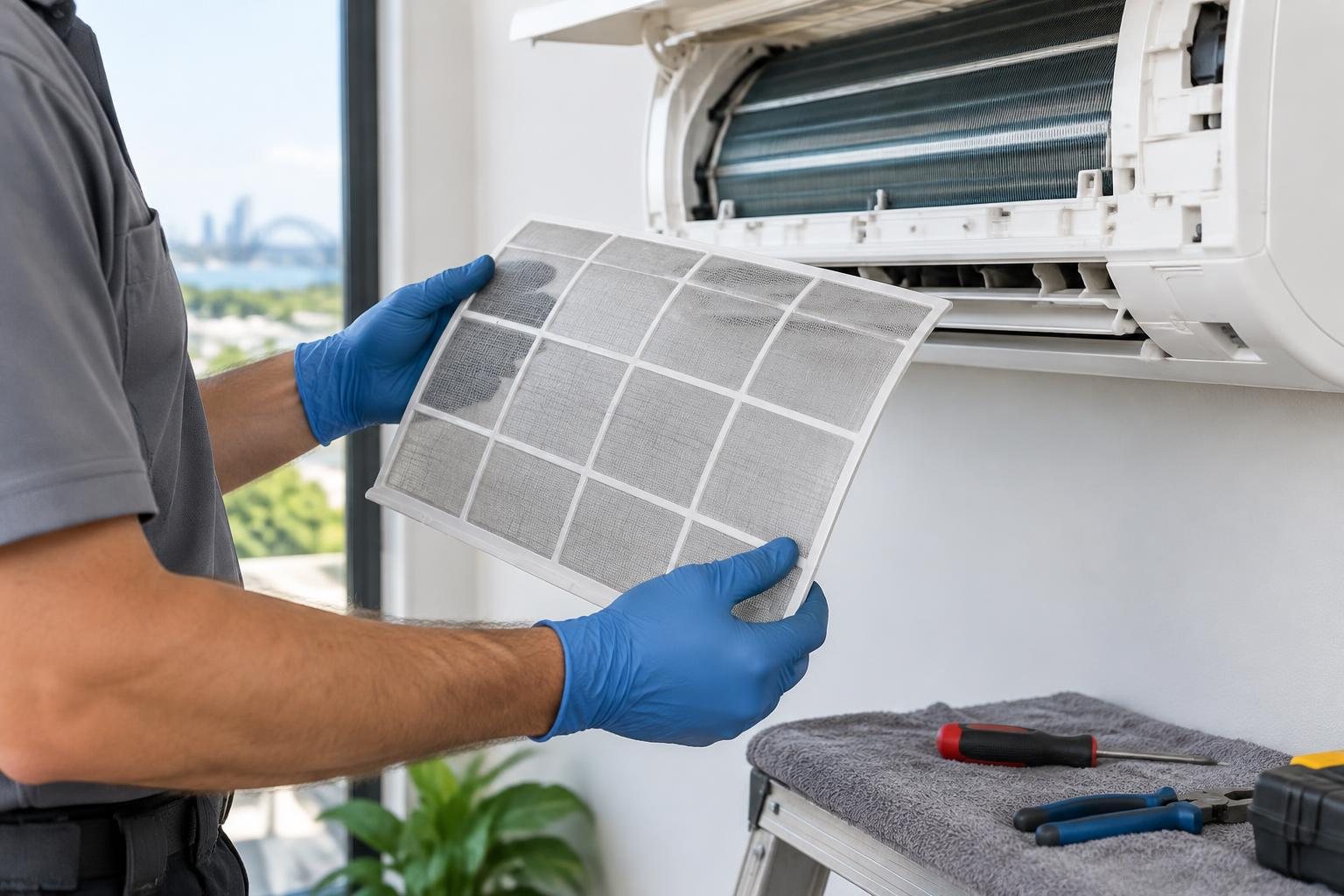
Yes. Heating relies on strong indoor and outdoor airflow. Dirty filters, blocked returns, closed supply registers, or matted outdoor coils choke output. In ducted systems, leaky or crushed ducts and clogged return grilles are common in older Canberra homes.
- Check and clean indoor filters every 4–6 weeks in winter.
- Keep returns clear — no furniture or curtains blocking them.
- Open supply registers fully in heated rooms; avoid shutting many zones at once.
- Inspect the outdoor unit; clear leaves and gently hose the finned coil.
Strata-managed blocks in Braddon often restrict outdoor unit placement; tight clearances reduce performance. If airflow checks don’t fix it, book air conditioning servicing to test static pressure, duct leaks and coil condition.
Is the unit undersized or poorly positioned for your home?
Possibly. Canberra’s sub-zero mornings expose undersized or mispositioned systems. A 2.5 kW split suited for a small bedroom won’t warm an open-plan living area. Poor return air placement or supply to high-ceiling rooms also drags down heating performance.
- Signs: Runs constantly, never reaches setpoint, large temperature swings in wind or frost.
- Check: Compare your room’s heat loss to unit capacity; duct design and return placement matter.
- Solution: Reposition returns, add a transfer grille, or upgrade capacity where needed.
We cover these trade-offs in “Why does my ducted AC struggle on -10° mornings?” and What size split system do I need? If a replacement’s likely, review reverse cycle options for Canberra.
What thermostat or control settings stop proper heating?
Wrong modes and fan settings cause “no heat” complaints. Heating requires Heat mode, a setpoint above room temperature, and reasonable fan speed. Auto mode can hunt between cooling and heating, delivering tepid air.
- Set to Heat (sun icon), not Auto or Fan.
- Setpoint: 20–22°C for most homes; higher setpoints may increase energy use without faster heat.
- Fan: Auto or Medium avoids cold draughts and reduces noise.
- Disable “Eco” or “Quiet” if it throttles output too much in frost.
- Timers: Ensure no off-timers or sleep modes cut heating overnight.
In zoned ducted systems, avoid closing too many zones; low airflow can trip safety or extend defrost.
Does refrigerant loss reduce heating output?
Yes. A leak lowers pressure and reduces heat transfer, often showing as longer defrosts, icy coils and poor heating. Refrigerant work is licensed; no DIY. ARCtick-certified technicians must find and fix the leak before recharging — topping up without repair is unsafe and non-compliant.
- Clues: Oily residue on joints, hissing, persistent icing, and low suction pressure readings.
- Action: Stop using heating if icing is severe; book a licensed technician.
- Check licensing: Look for the Tick for ARCtick credentials.
Can the reversing valve or sensors fail in cold weather?
They can. A stuck reversing valve or failed coil prevents switching into heat. Faulty thermistors misread coil or air temperatures, causing erratic defrost or early shutdowns. Control board faults are less common but possible after power events.
- Symptoms: No heat even when set correctly; loud click but no mode change; frequent short cycling.
- Diagnosis: Electrical testing of coils, thermistor resistance checks, and on-board diagnostics by a technician.
- Fix: Replace failed components; verify safe operation per AS/NZS 3000 electrical standards.
Cold-climate models from brands like Daikin can include improved defrost logic and low-ambient heating performance, helpful for Canberra’s frosts.
What will a licensed technician check during a heating callout?
A qualified technician systematically confirms controls, airflow, refrigeration circuit health and electrical safety. Expect a methodical sequence rather than guesswork; fixes are based on measurements.
- Controls and settings: Confirm Heat mode, setpoint, timers and zone operation.
- Airflow: Inspect/clean filters, measure static pressure, test fan speed, check return/supply blockages.
- Outdoor unit: Inspect coil, defrost sensor operation, fan motor, and clearance; clean as needed.
- Refrigeration: Check pressures, superheat/subcooling, and look for leaks; repair leaks before recharging.
- Electrical: Test reversing valve coil, thermistors, compressor start gear, and board; verify per AS/NZS 3000.
- Ducts (ducted): Inspect for leaks, crushed sections, and insulation; test zone motors and dampers.
After rectification, they re-commission in Heat mode, verify defrost behaviour, and confirm steady-state supply temperatures and airflow. Any refrigerant handling must be done by an ARCtick-licensed professional.
What Canberra factors change performance and costs?
Our climate and housing stock matter. -5°C frosts increase defrost frequency. Older brick-veneer homes in the Inner North/South often have duct leaks and poor returns, while newer Gungahlin townhouses may have compact spaces and strata constraints that limit unit size or placement.
- Climate: Extended frosts and fog reduce outdoor coil efficiency; smoke events add filter loading.
- Homes: 1960s–80s builds often lack insulation and have leaky ducts; upgrades improve heating performance.
- Energy policy: The ACT’s transition from gas encourages efficient reverse cycle selection and maintenance.
- Rebates: ACT Government Home Energy Support may assist eligible households; check program details via ACT Government channels.
- Energy ratings: Choose high-star models using the Energy Rating database for cold-climate suitability.
How much do winter heating repairs and servicing cost in Canberra?
Guide only, not a quote. Heating repair and service costs vary with access, model, parts availability, and whether it’s a split or ducted system. The ranges below reflect typical Canberra scenarios; we’ll confirm pricing after on-site diagnosis.
| Service or repair | Typical Canberra range (AUD) | Notes |
|---|---|---|
| Diagnostic callout (weekday) | $150–$250 | First hour on site; confirms cause and options. |
| Standard winter service (split system) | $180–$320 | Filters, coil clean, drain, electrical and defrost checks. |
| Deep clean (split) | $250–$450 | Disassembly and coil flush; helpful for clogged indoor coils. |
| Ducted system service | $280–$520 | Includes duct, return, and zone checks; plus coil and controls. |
| Thermistor (sensor) replacement | $180–$350 | Part plus labour; calibrates defrost and room readings. |
| Refrigerant leak test and repair | $350–$950 | Leak repair mandatory before recharge; price depends on access. |
| Reversing valve coil replacement | $220–$420 | Electrical component; valve body extra if required. |
| Outdoor fan motor replacement | $350–$750 | Varies by brand and motor type (EC vs AC). |
| Control board (PCB) replacement | $450–$1,200 | Availability varies by brand/age; includes programming. |
| Duct leak repairs (minor) | $220–$480 | Seal returns/supplies; major ductwork is more. |
If your system is at end-of-life or undersized, we’ll discuss upgrade paths. For a broader view, see our best air conditioner for Canberra weather guide, or talk with us about repair vs upgrade options.
What maintenance prevents winter heating issues?
Regular servicing and good housekeeping keep heating strong and reduce defrost time. A trained eye catches issues before they become breakdowns.
- Clean or replace filters monthly in heavy winter use; more often with pets or smoke residue.
- Clear outdoor coils and maintain at least 300 mm clearance; avoid enclosing units.
- Schedule annual servicing in autumn to prepare for frosts.
- For ducted systems, inspect returns and ducts for leaks or crushed sections.
- Run the system for 15 minutes in Heat mode monthly in shoulder seasons to keep valves moving.
Book a pre-winter check with our Air Conditioning Servicing Canberra team to maximise comfort through frosty mornings.
When should you call Capital Climate Solutions?
Call if basic checks don’t restore heating or any safety-related symptoms appear. We provide clear diagnosis and options tailored to Canberra homes, whether a split, multi-split or ducted system.
- Persistent icing or defrost that never clears.
- No heat despite correct settings and clean filters.
- New noises, tripping, or burning smells.
- Uneven heating in multi-zone ducted systems.
For urgent winter breakdowns and safe repairs, our Air Conditioning Repairs Canberra service prioritises heating faults during cold snaps.
Frequently asked questions
Why does my reverse cycle blow cold air during heating?
That’s usually a defrost cycle. On frosty mornings, the outdoor coil ices up and the system briefly switches to cooling to melt ice. You’ll feel cool or neutral air indoors, often for 3–10 minutes, then heating resumes. If ice never clears, book a technician.
How long should a reverse cycle take to warm a room in winter?
From a cold start, expect noticeable warmth in 5–10 minutes and steady comfort in 20–30 minutes for an appropriately sized unit. Undersized or poorly placed systems take longer. Defrost cycles can briefly interrupt heating on frosty mornings.
Should I use Auto or Heat mode in Canberra winters?
Use Heat mode in winter. Auto can toggle between heating and cooling near the setpoint, producing tepid air and discomfort. Set 20–22°C with Auto or Medium fan. Avoid Quiet/Eco if output is insufficient during frosts.
Is it normal for the outdoor unit to ice up?
Light frost is normal and cleared by defrost cycles. Persistent thick ice, especially if it doesn’t clear after a defrost, suggests low airflow, a defrost fault, or low refrigerant. Stop using the system and book a licensed technician if icing is severe.
Can low refrigerant be topped up without fixing a leak?
No. ARCtick regulations require locating and repairing the leak before recharging. Topping up without repair is unsafe and non-compliant. Always use an ARCtick-licensed technician; verify credentials at Look for the Tick.
How do energy ratings help with winter heating?
The Energy Rating label and database indicate seasonal efficiency. Higher star ratings generally mean better performance. Some models are optimised for cold climates. Compare models at the Australian Government’s Energy Rating site when planning upgrades.
Why does my ducted system heat bedrooms poorly?
Common causes are undersized branches, long runs, closed doors without transfer paths, or poor return placement. Adding transfer grilles, balancing dampers, or reworking duct sections can improve bedroom heating. See our guide on transfer grilles vs jump ducts.
Does a higher setpoint heat faster?
No. Most systems heat at a fixed maximum rate until the setpoint is reached. Setting 26°C instead of 21°C won’t heat faster; it simply runs longer and may overheat the space. Aim for 20–22°C for comfort and efficiency.
Is it okay to close most ducts to focus heat on one room?
Avoid closing many ducts or zones; it starves airflow and can trip safeties or increase defrost. Instead, balance airflow properly and ensure a clear return path. A technician can measure static pressure and set safe damper limits for your system.
Should I cover the outdoor unit in winter?
No. The outdoor unit must breathe and shed ice; covers restrict airflow and can cause icing and faults. Keep the unit clear of debris and allow adequate clearance around the coil for safe and efficient operation.
How often should I service my air conditioner in Canberra?
Annually is a good baseline, with filter cleaning every 4–6 weeks in winter. High-use homes or those with pets may need more frequent filter maintenance. See our local advice in how often to service in Canberra.
Need reliable winter heating now? Call Capital Climate Solutions on 0434 096 497 or send us a message. We diagnose, repair and optimise reverse cycle heating across Canberra’s frosts — safely and efficiently.
Replacing gas heating: compare the whole changeover
Reverse-cycle systems move heat rather than producing all of it through an electric element. The ACT Government recommends them as an efficient heating and cooling option, but a household's savings depend on equipment performance, insulation, tariffs and operating habits. Compare heat delivered and annual use, not just the gas and electricity unit prices.
A gas-to-electric changeover may involve electrical supply work, duct inspection, removal of the old heater and separate arrangements for the gas connection. If gas remains for hot water or cooking, its supply charge may continue. Obtain an itemised scope and investigate current assistance before signing an installation contract.
Check rebates and loans before ordering
ACT Home Energy Support has concession-card, residence, property-value and workshop requirements. Eligible upgrades and rebate limits must be checked against the current participant guidelines. The Sustainable Household Scheme is a loan rather than a general cash rebate; its current general terms include interest, while some concession arrangements differ.
Do not assume every supplier or product is eligible. Confirm the required approval sequence with the program and loan provider before paying a deposit. NSW properties, including Queanbeyan, are not covered simply because an installer also serves the ACT. Program links below are official references, not a promise that an application will succeed.
Sources and further reading
- Australian Government — Zoned Energy Rating Label
Explains climate-specific heating/cooling ratings, output capacity and noise figures; not a guarantee of a household's bills.
- Australian Refrigeration Council — Look for the Tick
Find licensed refrigeration businesses and check refrigerant-handling requirements. This link does not certify this business.
- ACT Government — Choosing reverse-cycle heating and cooling
Compares split, multi-split and ducted systems for Canberra homes. Actual running costs depend on the building, tariffs and operation.
- ACT Government — Home Energy Support rebates
Eligibility, workshops, property-value limits and eligible upgrades. Approval is not automatic; check current rules before ordering.
- ACT Government — Sustainable Household Scheme
Current loan terms and eligible products. The general scheme now advertises a 3% low-interest loan; concession arrangements and earlier applications have different terms.
These sources support the general guidance, not this business's prices, credentials or project outcomes. Confirm current product and program conditions before committing to work.
Talk to Canberra's air conditioning specialists
Free onsite quotes across Canberra. Same-week bookings for most jobs.